


“All clients’ HSE departments have informed the Project Site Manager that the company must appoint a Radiation Safety Officer (RSO) to supervise radiation safety for personnel working with radiation throughout the entire project period (including during the RSO’s leave). The client referred to the Ministerial Regulation prescribing the standard for management and administration of occupational safety, health, and work environment in relation to ionizing radiation work, B.E. 2547, as the basis.”
The author expressed concern not because of disagreement or negative intent, but because the legal requirements are often applied without a clear understanding of which regulation should be used, who is responsible, and how safety management and supervision should be implemented.
This topic relates to radiation personnel within an organization, including industrial workers, production personnel, and others involved in or responsible for radiation-related work. In practice, written legal requirements can be interpreted differently—especially regarding the control and supervision of radiation activities, where responsibilities may fall under two different regulatory authorities, particularly in workplaces where radiation work is carried out.
Radiation-Related Personnel in the Workplace (Current Classification)
- Responsible Person – Technical operations for radiation work
(Certification issued by the Ministry of Labour) - Responsible Person – Technical operations related to radiation
(Certification issued by the Ministry of Science)
2.1 Radiation Safety Officer (RSO) – Basic / Intermediate / Advanced
(Certification issued by the Ministry of Science)
- Professional Practitioner in Science and Radiation Control Technology (Nuclear Field)
(Certification issued by the Ministry of Science) - Radiation Operator
(Certification issued by the Ministry of Science)
The key point is to differentiate the similarities and differences in qualifications and supervisory responsibilities of radiation personnel. Many organizations must study and comply with the two relevant laws. The author would like to suggest that organizations closely review the matters discussed, which are often misunderstood.
At present, the Ministry of Labour’s regulation does not assign personnel specifically to manage projects or project sites as a “Project Site” under the responsibility of the Ministry of Science. Therefore, there is no clear requirement specifying which organization must appoint which roles, and this may cause misunderstanding because it suggests that radiation safety oversight is always required.
Therefore, when studying and understanding radiation personnel within an organization, we should return to the fundamental structure of ionizing radiation work management and radiation safety. It begins with the role of the regulatory authority, which issues regulations and controls operational procedures, as follows.
Radiation Laws and Regulations, Including Relevant Ministerial Authorities
The following article is not intended to criticize government administration, nor to create any negative sentiment toward professional colleagues. The author simply aims to share perspectives on this matter in order to provide useful information and help prevent misunderstanding. The author believes that knowing the facts and understanding the correct legal requirements is beneficial, and encourages all readers to approach the topic with awareness and clarity.
Therefore, in this section, the author will review, analyze, and categorize the relevant radiation-related laws and regulations, in order to establish appropriate and compliant guidelines for workplaces and organizations, in accordance with the applicable legal requirements.
Management of Radiation Personnel Within an Organization
The management of radiation personnel within an organization, according to this discussion, should be reviewed and assessed for compliance with laws and regulations issued by the Ministry of Labour and the Ministry of Science and Technology. The referenced legal framework and operational management steps include the following:
- Ministerial Regulation prescribing standards for management and administration of occupational safety, health, and work environment in relation to ionizing radiation work, B.E. 2547
(Ministry of Labour)
- Ministerial Regulation prescribing conditions, licensing procedures, and operations related to special nuclear material, source material, by-product material, or atomic energy, B.E. 2550 (Ministry of Science)
- Notification of the Atomic Energy for Peace Commission: Radiation safety standards, B.E. 2504 and B.E. 2549 (Ministry of Science)
- Notification of the Atomic Energy for Peace Commission: Standards for training Radiation Safety Officers (RSO) (Ministry of Science)
- Science and Technology Promotion Act, B.E. 2551 (Ministry of Science)
- Regulation of the Science and Technology Professions Council on professional practice in science and technology control (Nuclear field), B.E. 2557 (Ministry of Science)
All relevant laws and regulations have now been outlined. Next, we will begin to analyze and break down the structure and roles of radiation personnel step by step, in parallel (please get ready). We will start with:
1.Reviewing the organization’s initial context to determine the appropriate management of radiation personnel.
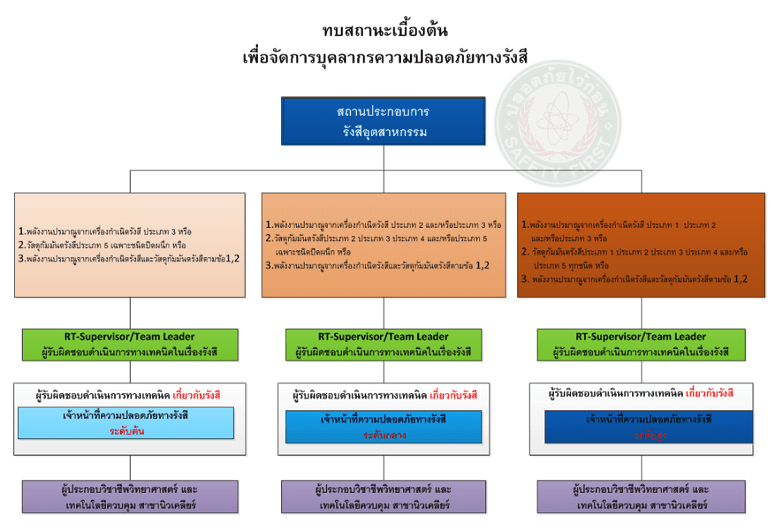
From the diagram above, it provides one example of an approach for reviewing an organization’s initial situation. This method is used for determining the work scope.
The work scope referenced under the relevant legal requirements is ACDF, which refers to radiation personnel that an organization must appoint—personnel with the required qualifications who will be responsible for performing duties as specified by law within the organization or at another operational site (Project Site). The key considerations include which radiation equipment or radiation sources the organization possesses and uses. For example:
Organization A
Operating and using an industrial radiographic equipment with a gamma-ray source (Gamma Ray Projector) (Type 2)
Operating and using a nuclear gauge (Nuclear Gauge / Level Gauge Cs-137) (Type 3)
Therefore, based on this diagram, Organization A must have the following radiation personnel:
1.1 Responsible Person – Technical Operations in Radiation Work (Ministry of Labour)
1.2 Responsible Person – Technical Operations Related to Radiation (Ministry of Science)
1.2.1 Radiation Safety Officer – Intermediate Level (Ministry of Science)
1.3 Professional Practitioner in Science and Radiation Control Technology (Nuclear Field) (Ministry of Science)
From the Example of the Initial Situation Assessment
Using the approach shown above to manage radiation personnel helps ensure that the organization has appropriate radiation personnel, as required by law. However, the method above does not include the Radiation Operator role. In addition, it should be considered that organizations may have radiation personnel assigned to different positions, either within the organization or at other operational sites (Project Site). This leads to questions about whether there are similarities or differences among radiation personnel roles 1–3 as presented in this example.
Therefore, in the next step of radiation personnel management, the author will present an overview of the scopes of responsibility for radiation personnel, based on the relevant legal requirements.
2. Radiation Personnel Management
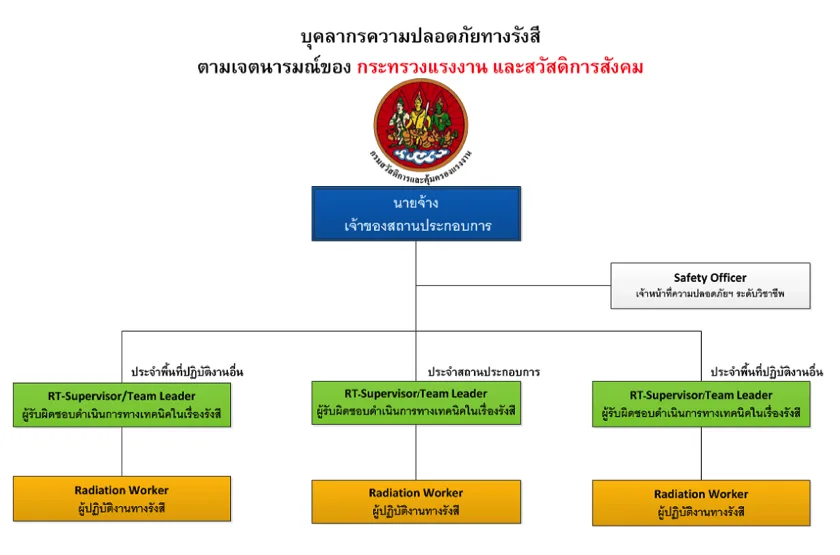
Defining the scope of responsibilities of radiation personnel according to the ministerial regulation of the Ministry of Labour
Responsible Person for Technical Operations in Radiation Work
Qualifications
- Holds an educational qualification of not less than a bachelor’s degree (or equivalent) in the field of science, and has studied and passed at least three subjects related to radiation hazard prevention.
…or…
- Has completed a training course on radiation hazard prevention conducted by the Office of Atoms for Peace, or an equivalent training institution that is officially recognized and certified by the Ministry of Labour.
Scope of Responsibilities
- Serves as the Responsible Person for Technical Operations in Radiation Work at the organization and at other operational areas (Project Site), throughout the period of radiation-related operations.
- Provides recommendations and guidance to the employer and employees regarding safety practices for radiation work, including radiation safety procedures, guidelines, or radiation safety regulations to be followed in operations.
- Inspects radiation safety practices, including verifying operational procedures and ensuring the readiness and proper usability of radiation equipment/sources, and reports inspection results to the employer.
- Reports the number of radiation sources/equipment and the radiation intensity level of the radiation-generating equipment.
- Reports any changes in the number of sources/equipment or changes in the radiation intensity level of the radiation-generating equipment.
- Reports on the performance of duties as the Responsible Person for Technical Operations in Radiation Work.
Article Author: Mr. Krai Sitthong
- B.Sc. (Industrial Hygiene), Occupational Health and Safety
- Master’s Degree, PH045-Koon52-Occ.36
- Safety Department Manager
- Professional Safety Officer
- Radiation Safety Officer – Advanced Level
- Professional Practitioner in Science and Radiation Control Technology (Nuclear Field)
- This article is protected under the Copyright Act B.E. 2537 (1994)


